
Most brand projects take three to six months, mostly calendar. Scoping a brand identity in four weeks, week by week, and when it doesn't fit.
Most brand identity projects take three to six months. I have worked on the inside of enough of them to know that two-thirds of that time is not work. It is calendar. It is waiting for stakeholder reviews, waiting for legal, waiting for the next workshop, waiting for the founder to come back from a board offsite. The actual hours of design are a small fraction of the elapsed weeks.
We run brand identity projects in four weeks. Not because we are faster than other studios, we are not. We are simply more aggressive about what counts as real work and what is procedural drag.
What a four-week brand sprint looks like
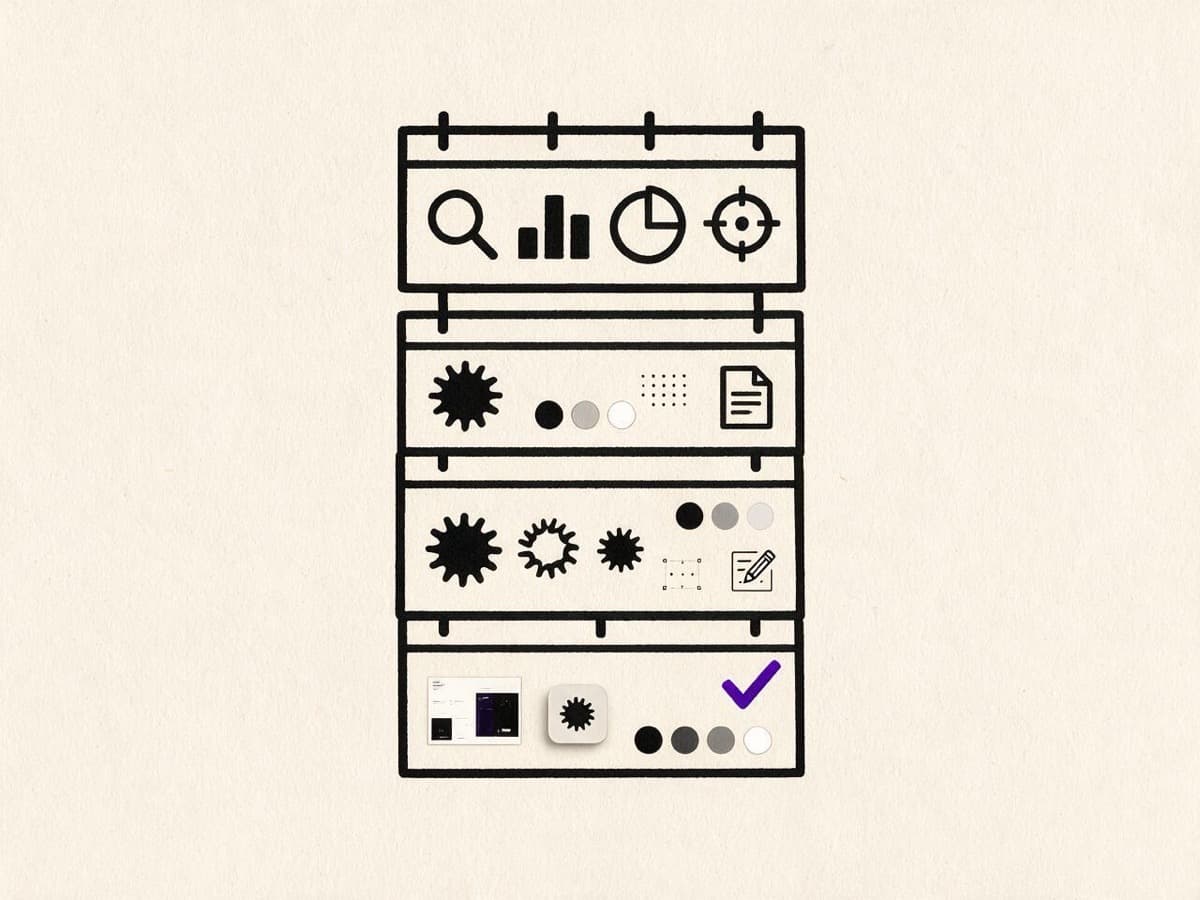
The structure is fixed. Four weeks, four distinct phases, one delivery at the end of each week.
Week one: discovery and direction. Three workshops. A founder interview. A competitor scan. A read of the existing materials. By Friday, a written direction document with three narrative pillars and a single sentence describing how the brand should feel. No visuals yet. The direction is approved or rebuilt before week two starts.
Week two: visual exploration. Two distinct directions, each pushed to the point where they are recognizably different. Not three. Not five. Two. Each direction has a logo, a type pairing, a color palette, a sample of brand-in-use across three surfaces. End of week, the client picks one. They do not pick a hybrid. They pick one.
Week three: system build. The chosen direction is hardened into a working system. Tokens are named. Components are built. The logo gets its variants and clear-space rules. The type scale is locked. Voice rules are drafted. At the end of the week, the client sees the system applied to six real surfaces, homepage, app screen, email, social, slide, error state. Not mockups. Real applied work.
Week four: documentation and handoff. The system is documented for the people who will use it after we leave. A short guidelines doc, twenty pages at most. A token file in JSON. A component library in code. A loom video walking through how to apply the system to a surface we did not build. The project ends with the client able to use the brand without us.
Why this works
The four-week constraint is not a trick. It is a forcing function. When you have four weeks, you stop having opinions about whether to do a logo exploration in four directions or two. You do two. You stop scheduling three rounds of stakeholder reviews. You schedule one. You stop waiting for the founder to react to the work over a weekend. You sit with them on Friday afternoon and finish the review in two hours.
The longer a brand project runs, the more decisions get made by exhaustion rather than judgment.
The reason this works is not that four weeks is the right amount of time for a brand. It is that the first four weeks of any brand project are where ninety percent of the real decisions get made. The remaining months are usually spent rationalizing, revising, and slowly forgetting what the original direction was trying to do. By compressing into four weeks, we keep the conviction of week one alive through week four.
What we cut
To make this work, we cut things other studios include.
- Endless competitor decks. We look at competitors for one hour. We name three things to avoid. We move on.
- Multi-stakeholder workshops with marketing, sales, and ops. The founder picks one or two people. They have decision power. Nobody else is in the room.
- Mood-boarding as a separate billable phase. Mood-boarding happens in the founder interview. It takes ninety minutes.
- Six-figure photo shoots. We use existing photography or commission targeted shots in week four. Brand identity is not a photo library.
- Brand books as glossy printed objects. The book is a Notion doc with code-ready tokens. Nobody prints brand books anymore.
What we add
What we do include, and what most three-month brand projects skip:
- Real engineering involvement from week one. If we are building tokens, an engineer sits in the workshops. The brand system is built in code, not translated to code.
- A working website applied surface by end of week three. Not a mockup. A live page on a staging URL. The brand is real when you can see it in the browser.
- Voice rules with examples. Every voice rule has a sample of compliant and non-compliant copy. Without examples, voice rules are religion.
- A motion grammar. Three easing curves, four durations, written down. Most brand identities ship without any motion thinking. Ours do not.
When the four-week model fails
It fails when the client cannot move fast. If the founder is not the decision-maker, if every direction has to be circulated to a committee, if the legal team needs two weeks to clear every word, the model breaks. We screen for this in discovery. If we cannot get a one-or-two-person decision team, we either negotiate that constraint up front or we decline the project. There is no middle path that ends well.
It also fails when the client is not actually trying to ship. Some clients want a brand project because they want a brand project, not because they have a launch behind it. The four-week sprint assumes there is something on the other side that will use the brand within thirty days. Without that, the energy dissipates.
What you get at the end
A working brand identity, applied to six real surfaces, documented in code and prose, handed off to a team that can use it. Four weeks. No surprises. No extension. The next thing is to ship.
A three-month brand project promises depth. What it delivers is calendar. The four-week sprint promises a working system. What it delivers is the brand, actually being used, before anyone has had time to change their mind.
Frequently asked questions
How long does a brand identity project take?
With a small decision team and a clear launch, a complete brand identity can be delivered in about four weeks: direction, visual exploration, system build, and documentation with handover.
What do you receive at the end of a brand identity project?
A working identity applied to real surfaces, short guidelines, a token file for developers, components in code and an organised set of source and export files.